
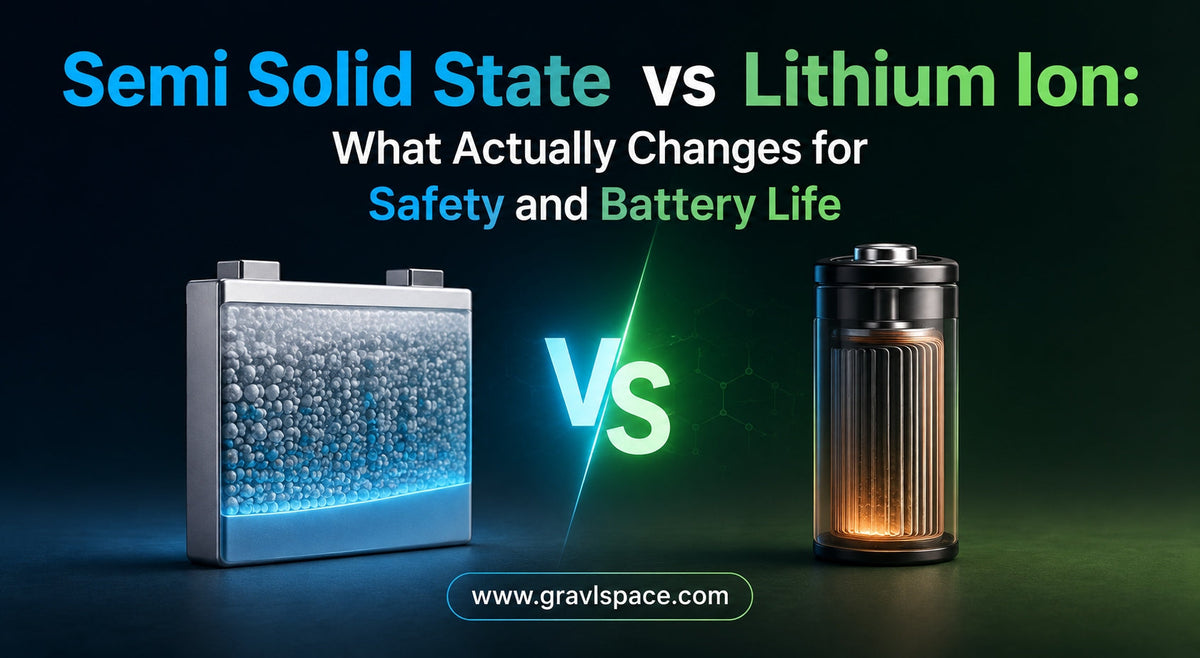
Every power bank you've ever owned almost certainly used the same core technology, a lithium-ion or lithium polymer cell with a liquid electrolyte inside. It's a mature, well-understood technology, and it's also the reason power bank fires and swelling batteries show up in the news often enough to make people nervous about buying one at all. When people search semi-solid-state battery vs lithium-ion, they're usually trying to work out whether this is a genuine change to that formula or just a new marketing label on the same chemistry, and it's a fair question worth answering properly.
This isn't a simple story of one being completely safe and the other being dangerous. No battery chemistry is risk-free, and any brand claiming otherwise isn't being honest with you. What semi-solid state actually offers is a meaningful reduction in a specific kind of risk, along with a real, separate benefit for how long a power bank stays usable over time. Both of those claims deserve a proper explanation rather than a slogan.
What "Semi Solid State" Actually Means
Inside every lithium-ion battery cell sits an electrolyte, the material that allows charge to move between the two electrodes as the battery charges and discharges. In a standard lithium-ion or lithium polymer cell, that electrolyte is a liquid. It's an effective way to move charge, but it's also the component most directly involved when something goes wrong inside the cell.
A semi-solid-state battery replaces that liquid electrolyte with one that's partially solidified, sitting somewhere between a fully liquid and a fully solid-state battery. There's meaningfully less free-flowing liquid inside the cell, which changes how the battery behaves under the kind of stress that causes standard lithium-ion cells to fail badly.
Thermal Runaway, Explained Properly
You'll see the term thermal runaway battery used often in safety discussions, sometimes without much explanation of what it actually means. It's worth understanding properly, because it's the specific failure mode that both good design and better chemistry are trying to prevent.
Thermal runaway is a chain reaction inside a battery cell. Damage, a manufacturing defect, overcharging, or physical stress can cause a small amount of internal heat to build up. In a standard liquid electrolyte cell, that heat can trigger the electrolyte itself to break down, which generates more heat, which breaks down more of the cell, and so on, faster than the heat can dissipate. Once this chain reaction starts, it's difficult to stop, and it's the underlying cause behind the vast majority of publicized battery fires and swelling incidents.
A semi-solid-state cell doesn't eliminate this risk, since the chain reaction can still theoretically start under severe enough damage. What it does is remove much of the fuel that makes the reaction escalate so quickly once it begins. With far less free liquid electrolyte available, there's simply less material to feed the runaway process, which meaningfully reduces both the likelihood of a serious failure and how severe it becomes if one does happen.
Does Charging From a Power Bank Actually Damage Your Battery?

This question comes up constantly, and it deserves an honest answer rather than reassurance for its own sake. The short version is that normal charging, from any reasonably well-built power bank, doesn't meaningfully damage your device's battery beyond the ordinary wear that comes from using and charging it at all.
Every lithium battery, in your phone, your laptop, or the power bank itself, degrades slowly over hundreds of charge cycles regardless of what it's charged from. This is simply how the chemistry ages. What actually accelerates that wear isn't the source of the power; it's heat and poorly regulated charging. A cheap, badly made power bank supplying unstable or excessive current can genuinely cause more heat and more wear than a well-designed one supplying clean, properly negotiated power. A good power bank using proper USB-C Power Delivery causes no more wear on your device's battery than the original wall adapter it came with.
This is also where the power bank's own battery matters, separate from your device's battery. A power bank with a standard lithium-ion cell degrades faster over repeated charge cycles than a semi-solid-state cell does, simply because the liquid electrolyte breaks down gradually with heat and use in a way the partially solidified version resists better. This is a real, practical reason semi-solid-state batteries tend to last longer in service, not just a theoretical safety point.
How Long Does a Power Bank Last
If you've ever searched how long does a power bank last, the honest answer is that it depends heavily on build quality, chemistry, and how it's used, but there are useful general patterns worth knowing. A typical lithium-ion power bank, used regularly, tends to hold a meaningful percentage of its original capacity for somewhere around two to three years of daily use before degradation becomes noticeable in everyday terms, though this varies a great deal by brand and cell quality. Heavy heat exposure, frequent full discharges, and cheap internal components all shorten this timeline considerably.
A semi-solid-state power bank is built to extend this timeline meaningfully, because the underlying cell resists the gradual liquid electrolyte breakdown that drives most of that degradation in a standard cell. This is also the practical reason a brand can responsibly offer a longer warranty specifically on the battery itself for a semi-solid-state product. A warranty that long only makes sense if the chemistry genuinely supports lasting that long, since the alternative would mean the brand loses money honoring claims on batteries that were never built to survive that period in the first place.
There are also things you can control yourself that affect how long any power bank lasts, regardless of its chemistry. Avoiding full discharges to zero percent on a regular basis, keeping it out of direct heat like a car dashboard or direct sunlight, and not leaving it fully charged and unused for long stretches all help preserve capacity over time. None of these habits are unique to any one brand or chemistry, but they compound meaningfully over a few years of regular use, and they matter more the longer you intend to keep the power bank in service.
It's also worth setting realistic expectations rather than assuming any power bank lasts forever with proper care. Even the best-built cell, semi-solid-state or otherwise, degrades gradually through normal use, since this is a property of how lithium-based batteries work rather than a flaw specific to any particular product. The honest goal isn't a battery that never degrades; it degrades slowly enough that the warranty period and your realistic ownership timeline line up comfortably, without you needing to think about replacement earlier than expected.
What Semi Solid State Does Not Promise
It's worth being just as clear about the limits here as the benefits, since overstating this would undercut the entire point of explaining it honestly. Semi solid state chemistry does not make a power bank indestructible, immune to damage, or completely incapable of failing under extreme conditions. Physical abuse, exposure to genuinely extreme heat, or a serious manufacturing defect can still cause problems in any battery chemistry, semi-solid-state included.
What it does offer is a real, chemistry-level reduction in the specific failure mode responsible for most serious battery incidents, along with slower degradation over normal use. Those are genuine, meaningful benefits. They're just not the same as a guarantee of total safety, and no honest explanation of this technology should suggest otherwise.
Capacity Rating Doesn't Determine Safety
A separate misconception worth clearing up while we're here, since it comes up alongside chemistry questions constantly. A higher mAh capacity does not make a power bank less safe, and a smaller one isn't automatically safer either. Safety comes down to cell chemistry, protection circuitry, and build quality, not the size of the battery. A well-engineered, properly certified power bank at any capacity is safer than a poorly made one at any capacity, and comparing safety by capacity alone misses the actual factors that matter.
Certification Still Matters, Even With Better Chemistry
Semi-solid-state chemistry is a genuine engineering advantage, but it isn't a substitute for independent certification, and it shouldn't be treated as one. Look for BIS certification if you're buying in India, since it confirms a power bank meets an actual regulatory safety standard rather than relying solely on a chemistry claim from the brand itself. The strongest safety case combines both, chemistry-level design and independently verified certification, rather than leaning on either alone.
How This Gets Tested, Not Just Claimed
A fair question to ask any brand making a chemistry-level safety claim is how that claim is actually verified, rather than simply asserted. Reputable manufacturers test battery cells under controlled conditions designed to simulate the kind of stress that causes real-world failures, including punctures, crushing, overcharging beyond normal limits, and sustained heat exposure. These tests exist specifically because a cell chemistry claim that hasn't been tested this way is closer to a hypothesis than a verified fact.
BIS certification in India requires meeting specific safety benchmarks, which is one useful, independent check, but it's worth understanding that certification generally verifies a product meets a baseline standard rather than independently confirming every specific marketing claim a brand makes about its chemistry. This is why the most trustworthy explanations combine a genuinely defensible chemistry argument, of the kind laid out above, with real certification, rather than leaning on either one alone as if it tells the whole story by itself.
Reading Past the Marketing Language

Both lithium-ion and semi-solid-state power banks get marketed with confident, reassuring language, and it's worth developing a habit of looking past the adjectives to the specifics underneath. Phrases like advanced protection, premium cells, or industry-leading safety don't actually tell you anything verifiable on their own. A brand that states its actual cell chemistry, its certification details, and its specific protection mechanisms by name is giving you something you can check. A brand that only offers confidence-sounding adjectives isn't, regardless of how reassuring the language sounds.
This applies equally to any brand making these claims, not just less established ones. The specificity of the claim matters more than how premium the brand sounds, and it's a habit worth applying consistently rather than selectively.
GRAVL built the Core 30 as India's one of the first semi-solid-state power bank, specifically because the chemistry argument above is one worth acting on rather than just discussing. It's a 10,000mAh power bank, BIS certified, and backed by GRAVL's 4-year warranty, the longest currently offered on a power bank in India, with the battery specifically covered for three of those four years once registered. That length of coverage is only a responsible commitment because the underlying chemistry supports lasting that long, which is the same logic explained above applied directly to a real product rather than left as a general claim. You can see the full details on the semi-solid-state power bank collection.
If you're specifically choosing between a power bank for everyday phone use and one built for a laptop, it's worth knowing the Core 30 is sized for phones, tablets, and earbuds at 30W, not laptop charging. GRAVL's separate laptop power bank range, including the Axis 67 and Engine 240, exists for that higher wattage need instead, using standard lithium-ion cells matched to laptop-level output.
A Simple Way to Think About the Choice
If safety and long-term battery life genuinely matter to you more than anything else, and your charging needs are phones, tablets, and similar devices, a semi-solid-state power bank is a real, defensible upgrade over standard lithium-ion, not just a premium label. If you need to charge a laptop, the wattage and PD specification matter more than the underlying cell chemistry for now, since semi-solid-state technology at laptop-level capacities and outputs is still an emerging area across the industry generally.
It's also worth thinking about this less as picking a winner between two technologies and more as matching the right tool to what you actually need. Someone who travels constantly and worries about battery safety on planes and in hot climates gets genuine, practical value from semi solid state chemistry. Someone whose main concern is charging a demanding laptop at full speed gets more value from a power bank engineered around wattage and PD negotiation, where the cell chemistry, while still worth checking, isn't the deciding factor the way it is for a smaller, phone-focused device.
Either way, checking for genuine certification and a warranty length that reflects real confidence in the product remains the most reliable signal available to you, regardless of which chemistry you end up choosing. A brand that explains its reasoning clearly, states specific facts rather than vague reassurance, and backs its claims with a warranty long enough to actually be tested by years of real use, is giving you something worth trusting more than any single spec on its own ever could.
FAQ
What's the actual difference between semi solid state and lithium ion batteries?
A semi-solid-state battery replaces the liquid electrolyte found in a standard lithium-ion cell with one that's partially solidified. This meaningfully reduces the risk of thermal runaway, the chain reaction responsible for most serious battery fires, and it also tends to degrade more slowly over repeated charge cycles.
Does semi solid state chemistry mean a power bank can never catch fire?
No, and any claim suggesting complete fire immunity shouldn't be trusted. No battery chemistry eliminates risk entirely. Semi-solid-state significantly reduces the risk compared to standard lithium-ion, but it isn't a guarantee against every possible failure.
What is thermal runaway in a battery?
Thermal runaway is a chain reaction where internal heat buildup causes a battery cell to generate increasing amounts of heat faster than it can dissipate, potentially leading to fire or explosion. It's the underlying cause behind most publicized lithium battery incidents.
How long does a power bank typically last before it needs replacing?
A standard lithium-ion power bank used regularly tends to hold meaningful capacity for roughly two to three years of daily use before noticeable degradation, though this varies by build quality. A semi solid state power bank is built to extend that usable lifespan meaningfully, due to slower internal degradation.
Does charging a device from a power bank damage its battery faster than a wall charger?
No, not from a well built power bank using proper charging standards. Battery wear comes primarily from charge cycles and heat, not from the specific source of the power. A poorly made, badly regulated power bank can cause more wear, but this is a build quality issue, not something inherent to power banks generally.


Leave a comment
This site is protected by hCaptcha and the hCaptcha Privacy Policy and Terms of Service apply.